
How Casino Bonus Wagering Requirements Affect Your Withdrawals
By Priya Sandhu 10 min read


A casino bonus can’t usually be withdrawn the moment it lands in your account. In most cases it comes with a wagering requirement, also called a playthrough requirement. This is a condition that you place a set total amount of bets before the bonus, or the winnings linked to it, can become withdrawable cash. If a promotion says “10× wagering” on a £20 bonus, you’d normally need to place £200 in total qualifying bets first. That doesn’t mean losing £200. It means the combined value of all your stakes has to reach that figure.
That one number is only the start, though. What the multiplier applies to, which games count, how long you have, and what you’re allowed to bet along the way can all change how much play an offer really involves. This guide explains how the system works and how to read the terms before you decide whether an offer suits you at all.

What a wagering requirement actually measures
A wagering requirement counts turnover, not losses or profit. Every qualifying bet adds its stake to the running total, whether the bet wins or loses.
Imagine you have to wager £200 and you place forty £5 spins on an eligible slot. Those forty spins add up to £200 of turnover, and the requirement is met, regardless of whether your balance went up or down. Winnings that you re-stake count again when you bet them. That’s why a balance of £20 can, in theory, generate far more than £20 of turnover.
This is also the source of a common misunderstanding. A wagering requirement doesn’t tell you how much you’ll spend, win or lose. It tells you how much betting activity the casino requires before the bonus conditions are complete.
What does 30× wagering mean?
A 30× wagering requirement means you must place bets totalling 30 times a stated amount before the bonus-related funds can be withdrawn. On a £10 bonus, if the multiplier applies to the bonus only, that’s £300 of qualifying bets.
Players in Great Britain should know that the rules here have changed. Since 19 January 2026, the Gambling Commission has capped bonus wagering requirements at 10 times for operators it licenses. It has also banned promotions that require players to use two or more types of gambling, such as betting and slots, to qualify. Requirements of 30×, 35× or higher were common in British offers before the change, and they can still be found in promotions outside the British market. Higher multiples still appear in older guides and in offers aimed at other countries, so it’s worth knowing how they work, as well as where they no longer apply.
Does wagering apply to the deposit or the bonus?
It depends on the terms, and it is one of the most important details in any promotion.
Some offers apply the multiplier to the bonus amount only. Others have historically applied it to the deposit and the bonus combined. Some free-spin offers apply it to the winnings from the spins rather than to a bonus amount.
A worked example with hypothetical numbers
The figures below are illustrative only and don’t describe any specific casino’s terms.
Suppose a player deposits £50 and receives a £50 bonus.
20× on the bonus only: £50 × 20 = £1,000 of qualifying bets.
20× on the deposit plus the bonus: (£50 + £50) × 20 = £100 × 20 = £2,000 of qualifying bets.
Both offers could be advertised as a “100% bonus up to £50 with 20× wagering”. Yet one requires twice as much betting as the other.
Under the current British cap, the same pattern still shows how much the base matters. At 10× the bonus only, the £50 bonus requires £500 of qualifying bets. The Gambling Commission’s own explanation of the rule illustrates the multiplier against the bonus amount. Even so, players should always check exactly what the operator’s own terms count towards the total.
Why the headline bonus is not the whole story
Two offers can look nearly identical in an advert and behave very differently in practice. The useful way to think about this is as a set of linked conditions, not a single number.
The practical burden of a bonus depends on several factors working together:
The base. Which amount the multiplier applies to.
The multiplier. How many times that amount must be wagered.
Game contribution. How much of each stake counts towards the total.
Time. How long you have before the bonus expires.
Betting restrictions. Whether stakes are limited while the bonus is active.
Other promotion-specific terms. For example, excluded games or a cap on how much can be converted to cash.
This isn’t a formula that every casino follows. It’s a way of reading terms so that you see the whole offer rather than just its largest number. A bigger bonus percentage doesn’t improve your chances of winning on any game. It only changes the amount and conditions attached to the promotional funds.
The terms behind the headline number
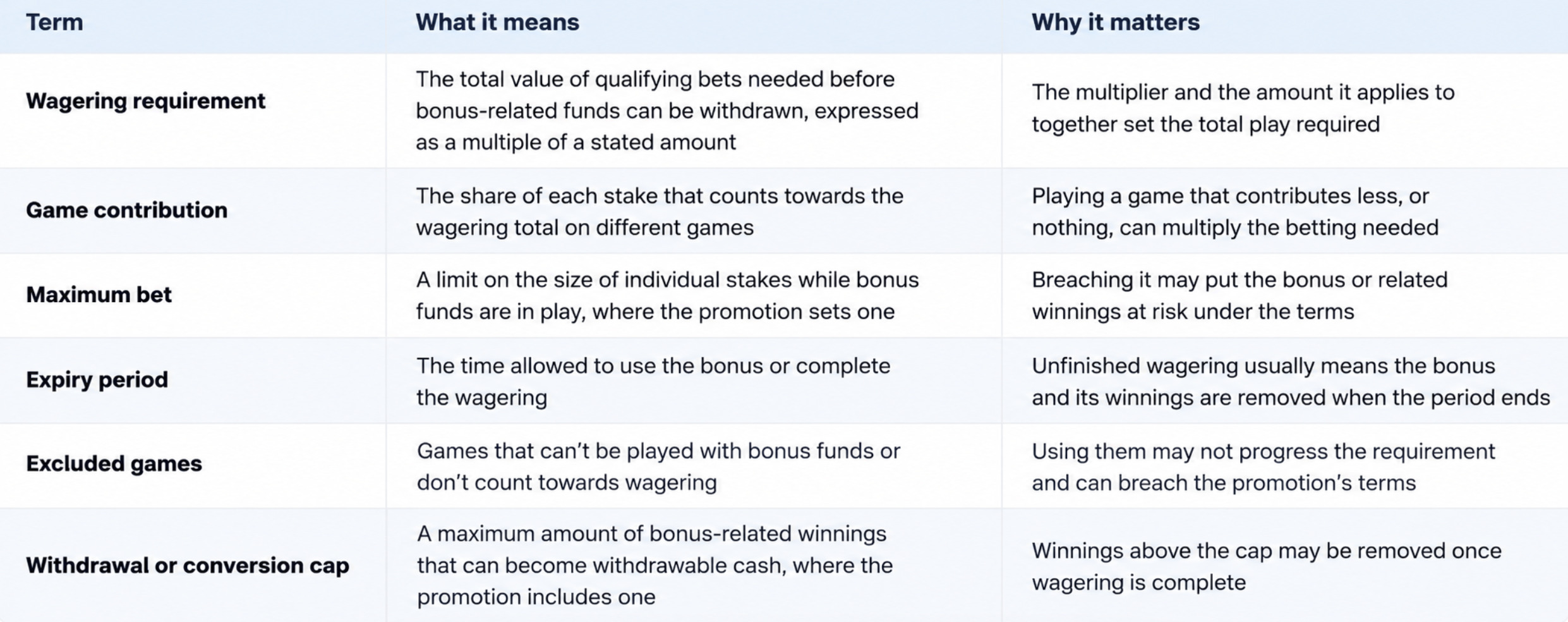
The table below summarises the conditions that most often affect whether bonus-related funds become withdrawable. Not every promotion uses every one of them, and the details vary between operators and between offers from the same operator.
Do all games count towards wagering?
Not necessarily. Many promotions use game contribution rules, which set how much of each stake counts towards the requirement depending on the game.
A promotion might count slot stakes in full but count only part of the stakes on certain table games, or exclude some games entirely. There’s no universal percentage. Each operator, and often each promotion, sets its own rules, and they can change between offers.
The effect can be large. Suppose, hypothetically, a player needs to complete £500 of wagering. If the chosen game contributes 100%, £500 of stakes completes the requirement. If it contributes 10%, only £1 of every £10 staked counts, so the same requirement would take £5,000 of stakes. The headline multiplier hasn’t changed, but the amount of betting has increased tenfold.
Some offers go further and restrict bonus play to a named list of games. This is particularly common with free spins, which are usually tied to one specific slot.
Can maximum bet rules affect bonus wagering?
Yes. Some promotions set a maximum stake per spin, hand or round while bonus funds are active or while wagering is incomplete. The limit is set in the terms of the specific promotion. There’s no single industry-wide figure, and some offers don’t have such a rule at all.
The reason these rules exist is straightforward. They stop bonus funds being used for a small number of very large bets. For the player, the practical consequence is that placing a stake above the stated limit, even once, may allow the operator to remove the bonus or the winnings attached to it, depending on how the terms are written. Because the limit may be set per bet rather than per session, it’s worth confirming it before playing, not after.
Bonus balance, cash balance and winnings
Online casinos often hold funds in different categories, though the exact system varies from one operator to the next.
Your deposited money is your own cash. Your bonus balance is the promotional credit added by the casino. Winnings linked to bonus play may be held as bonus funds until the wagering is complete, rather than going straight into your cash balance.
In the UK, the treatment of a player’s own money has been the subject of regulatory attention. Following action by the Competition and Markets Authority in 2018, operators committed to making sure players could access and withdraw their own deposited funds during a promotion, rather than having to play through a bonus first. In practice, withdrawing deposited money before completing the wagering will usually mean giving up the bonus and any winnings linked to it, so it’s worth checking how a particular operator handles this before accepting an offer.
Some casinos use the player’s cash first and the bonus balance second. Others use them in a different order, or keep them separate entirely. That order affects which funds are at stake on each bet and which winnings are restricted. The promotion’s terms, or the operator’s general bonus policy, should explain it.
What about free spins?
Free spins are usually tied to a particular game and a fixed stake per spin. The important question is what happens to the winnings. They may be paid as withdrawable cash, sometimes advertised as “no wagering” spins. Or they may be credited as bonus funds, which then carry their own wagering requirement, expiry period and, sometimes, a cap on how much can be converted.
Two offers of “50 free spins” can therefore lead to very different outcomes for the same winnings. Reading what happens after the spins are played matters more than the number of spins.
What happens if a bonus expires?
If the wagering isn’t completed within the stated period, the bonus funds and any winnings tied to them are usually removed. Expiry rules can be split into more than one stage. For example, a promotion may give you one period to claim or activate the bonus, and a separate period to complete the wagering once it’s active.
A short expiry window also changes the practical demands of an offer. Completing a large requirement in a few days encourages faster and more concentrated play than the same requirement spread over a month. That’s a relevant consideration for anyone trying to keep their gambling within set limits.
Can you withdraw a casino bonus immediately?
Usually not, unless the promotion is specifically advertised as wager-free. Before assuming that bonus-related funds are withdrawable, check the following:
Has the full wagering requirement been completed, on games that contribute?
Is the promotion still within its expiry period?
Were any excluded games played with bonus funds?
Did any stake exceed a maximum-bet condition, if the promotion has one?
Does the promotion include a cap on how much can be converted to cash?
Has the account been fully verified? Identity and age checks are standard for operators licensed in Great Britain, and outstanding verification can delay any withdrawal, bonus-related or not.
How to compare two offers intelligently
Here is a hypothetical comparison. Neither offer describes a real promotion.
Offer A gives a £20 bonus with 5× wagering on the bonus only, so £100 of qualifying bets. It has a 30-day expiry and most games contribute in full.
Offer B gives a £100 bonus with 10× wagering on the bonus only, so £1,000 of qualifying bets. It has a 7-day expiry, a maximum-bet rule and a narrower list of contributing games.
Offer B looks five times larger. It also asks for ten times the betting, in less than a quarter of the time, under tighter conditions. That doesn’t automatically make Offer A the better choice, because the right answer depends on how a player intends to play, how much they’re comfortable spending and whether they want a bonus at all. What it does show is that the headline bonus figure alone tells you very little.
It’s also worth remembering that more wagering means more money exposed to the house edge. Casino games are designed to return less than is staked over time. A game with a published return-to-player (RTP) figure of 96%, for example, has a theoretical average return of £96 for every £100 wagered, though results over any one session vary widely. On that basis, £1,000 of wagering carries a much larger expected cost than £100. Bonuses don’t change this; they change only the funds and conditions involved.
The same logic applies to any named promotion. Someone looking into a specific offer, such as a tiffany luck casino bonus, gets more from the full terms than from the advertised percentage. The useful questions are which amount the wagering applies to, which games count and in what proportion, how long the offer runs, whether stake limits or conversion caps apply, and what happens to deposited funds if the player decides to withdraw early.
The practical takeaway
A wagering requirement describes how much betting a promotion asks for before bonus-related funds can become cash, and it is only the first of several conditions. The amount it applies to, game contribution, expiry, stake limits, excluded games and conversion caps all shape what is actually involved. Reading these together, rather than focusing on the size of the bonus, is the clearest way to judge whether an offer is relevant to you at all.
Declining a bonus is always an option, and for many players it’s the simpler one. If you choose to gamble, set a budget you can afford to lose, use the deposit limits and time-out tools that licensed operators provide, and treat any promotion as entertainment, not a way to make money.

Written by Priya Sandhu