How Independent Artists Build Sustainable Careers Beyond Social Media Algorithms
By Martha Ellison 19 min read
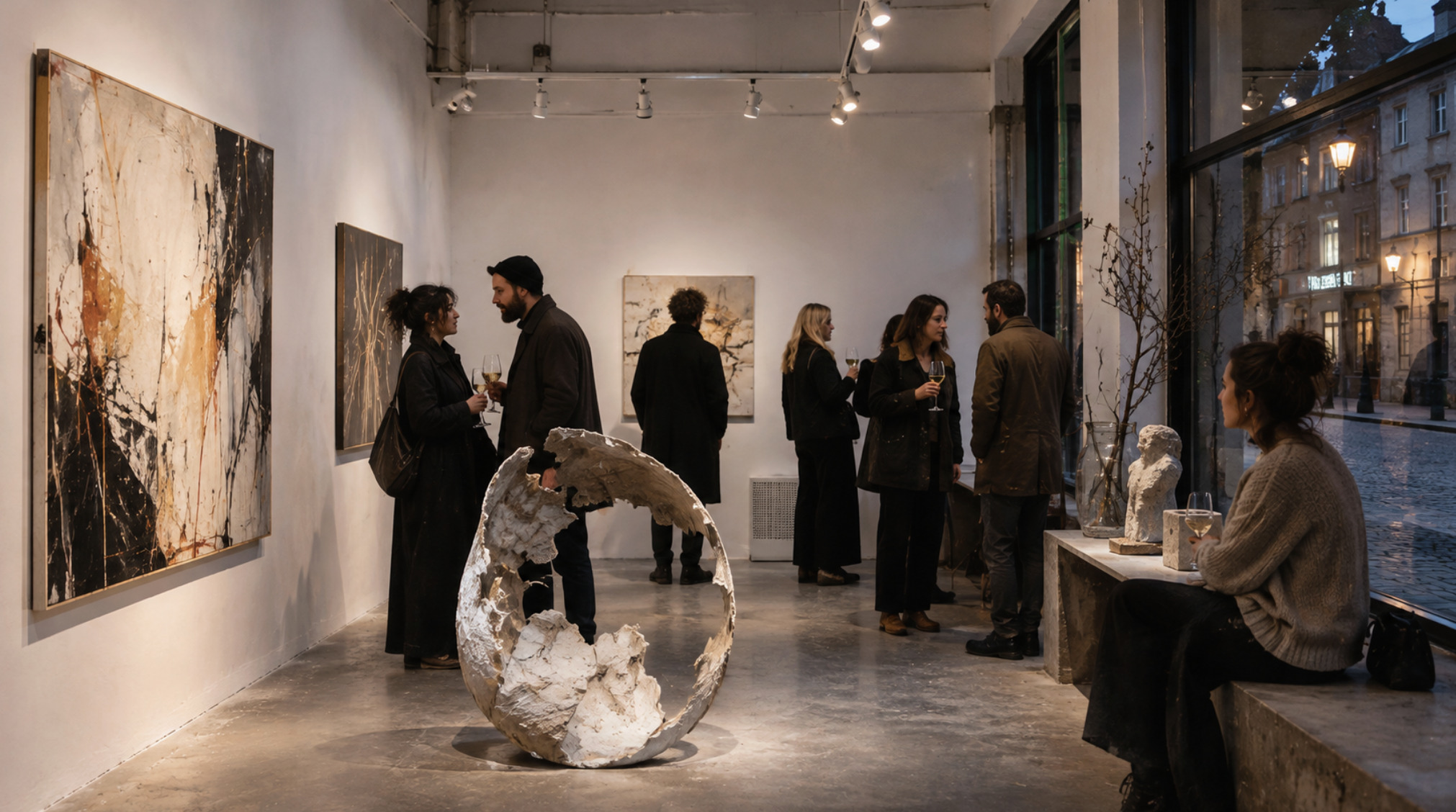
Visible, admired and broke
The artist described here is hypothetical. The scenario is illustrative and does not describe a real person.
A painter in her early thirties has, over four years, built an online following that most galleries would notice. Her process videos — layers of oil glaze building slowly into luminous, unsettling interiors — are shared widely. Collectors send messages. A curator from a regional institution follows her. Strangers tell her that her work has changed how they see their own homes.
And yet, in a typical month, her finances look nothing like her notifications. The studio rent is due on the first. A group show in another city requires her to pay for crating and a van. A print run must be paid for before a single print is sold. A residency she has been offered is unpaid, though it would be a mistake, she is told, to turn it down. The hours spent filming, editing and replying to comments do not appear on any invoice. Her work is seen by tens of thousands of people; her bank balance is seen only by her.
This gap — between cultural recognition and economic sustainability — is the subject of this investigation. It is not new. Artists have always depended on patrons, dealers, institutions and second jobs. What is new is the illusion, encouraged by platform metrics, that visibility itself is a form of capital. It can be. But it is rarely enough, and the evidence suggests that the economics of artistic work in the United Kingdom have become harder, not easier, in the age of the algorithm.
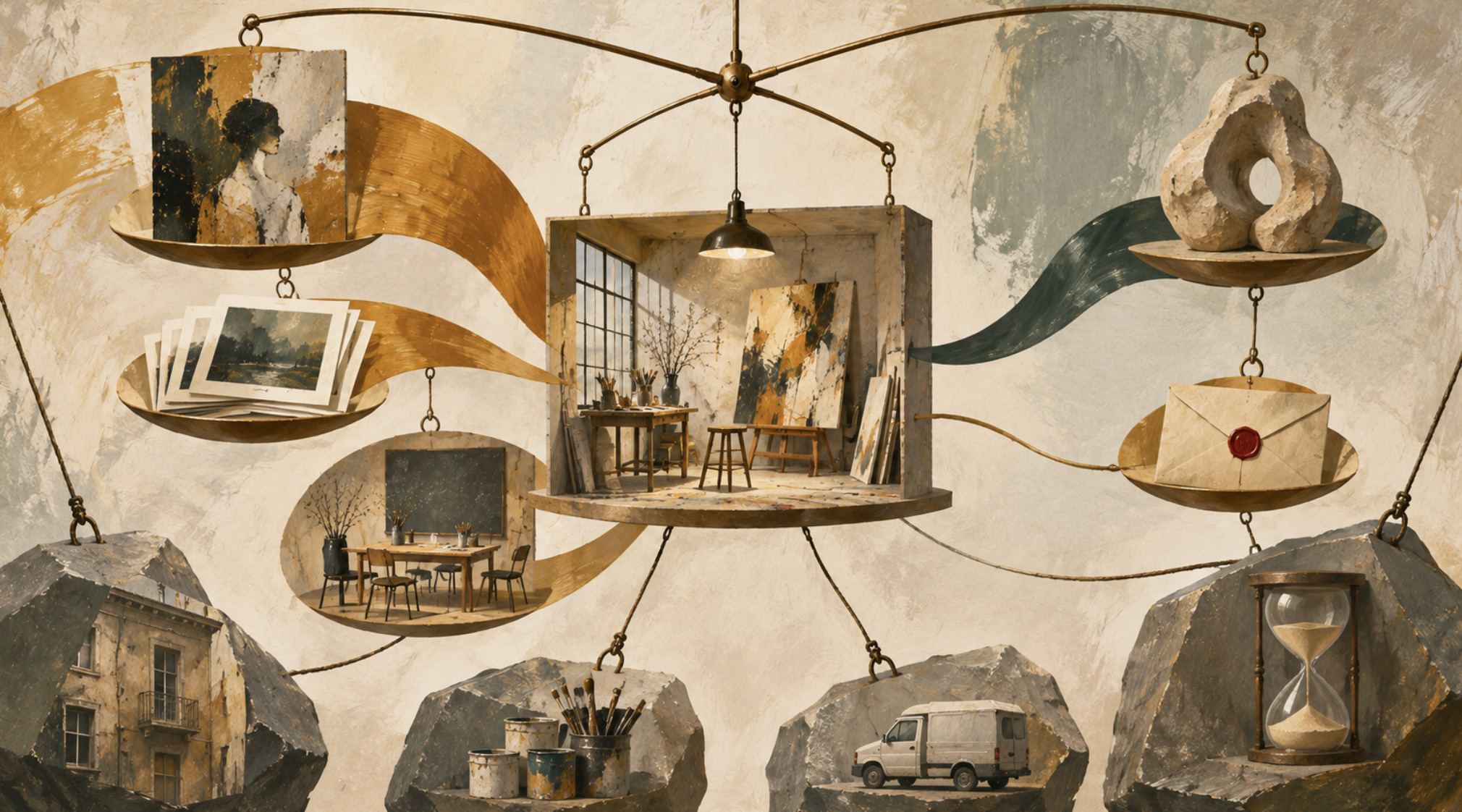
The economics of being an artist
The most comprehensive recent evidence on UK visuVisible, admired and brokeal artists' earnings is the UK Visual Artists' Earnings and Contracts Report 2024, produced by the University of Glasgow's CREATe centre and commissioned by the Design and Artists Copyright Society (DACS). Based on a survey of more than 1,200 artists, it found that artists whose primary occupation is visual art had a typical (median) self-employed income of £12,500 — well below full-time minimum wage earnings — and that median earnings had fallen sharply in real terms since the previous comparable survey in 2010. Around four in five respondents described their income from art as unstable or very unstable, and more than half held other jobs, many outside the creative sector. The report also identified significant gaps by gender, ethnicity and socio-economic background.
These figures need context. The survey drew on DACS members, with a modest response rate, and self-selected samples can over- or under-represent particular groups. A separate 2024 survey for Creative United by Coventry University's Centre for Creative Economies, published in late 2025, broadly mirrored the picture with a much smaller sample. No single dataset captures every kind of visual artist, and official statistics do not isolate artists' practice income from other work. But the direction of the evidence is consistent: for most artists, art alone does not provide a living wage.
Why sales are not income
Part of the problem is conceptual. A painting that sells for £3,000 does not put £3,000 into the artist's pocket. It is useful to distinguish four quantities:
Revenue is the money that comes in: sale prices, fees, grants, royalties.
Expenses are the costs of producing and selling work: materials, framing, studio rent, transport, insurance, marketing, a gallery's share of a sale, professional fees.
Profit is revenue minus expenses, and it is this, not revenue, that is subject to income tax and becomes personal income.
Cash flow describes when money arrives and leaves. A profitable year can still contain months in which the artist cannot pay rent, because costs are paid upfront and income arrives late, irregularly or in lumps.
The structure of artistic costs makes this especially acute. Many are fixed — studio rent and insurance are due whether or not anything sells — while revenue is irregular and often concentrated around exhibitions, fairs or the end of a commission. Exhibition preparation can absorb months of unpaid work and significant materials, transport and installation costs before any sale is possible.
Then there is unpaid labour. Administration, applications, accounts, correspondence, photography, social media and networking are all necessary and almost never directly paid. Research by a-n The Artists Information Company and others has documented the persistence of unpaid or underpaid exhibition opportunities in the UK, despite long-running campaigns for fair exhibition fees.
Income instability shapes artistic decisions. It can push artists towards work that sells quickly rather than work that develops slowly, towards smaller pieces that are cheaper to produce and ship, and away from ambitious projects that require capital they do not have. It also determines who can afford to remain an artist at all — a point that recurs throughout this investigation.
Why visibility is not a business model
Social media is not useless to artists. It lowers the cost of showing work to large audiences, enables direct contact with buyers, and allows artists outside major cultural centres to build reputations without gatekeepers. Curators, gallerists and collectors do look at artists' online presence. For some, particularly illustrators, printmakers and artists selling editions directly, it has become a genuine sales channel.
But visibility and viability are different things, and the gap between them is structural.
First, reach is rented, not owned. What an artist's followers see is determined by each platform's ranking systems, which change without notice. An audience built on one platform cannot be moved to another and cannot be reached independently.
Second, engagement is not conversion. A like, a share or an admiring comment costs the viewer nothing. A purchase, especially of an original work, is a considered decision involving trust, price and often physical encounter with the work. The proportion of followers who ever buy is typically small, and platforms reward the kinds of content — short, frequent, high-novelty — that do not necessarily correspond to the work collectors buy.
Third, content production is labour. Filming, editing and posting take time away from making work. For artists whose practice is slow, research-based or installation-focused, the demands of a feed can be actively distorting.
Fourth, personal branding is not professional credibility. Institutional curators and serious collectors tend to look for evidence of sustained practice: exhibitions, critical writing, peer recognition, commissions completed. A large following can open doors, but it rarely substitutes for those signals.
The more useful way to see social media is as one component of a professional ecosystem: a public portfolio, a discovery mechanism and a way to sustain relationships — most valuable when it leads people towards channels the artist controls, such as a mailing list, a website, a studio visit or a gallery.
The many ways artists earn money
Artists' income comes from sources with very different economic structures. A useful first distinction is between earned income — money paid in exchange for work, goods or rights — and financial support, such as grants, bursaries and fellowships, which is awarded rather than earned in a market transaction. Loans, which must be repaid, are different again. Within earned income, the important variables are scalability, predictability and how much each sale or contract depends on someone else's decision.
Original artworks have the highest value per item and the least scalability: each work is made once, takes time to produce, and sells irregularly. Prices depend on reputation, scarcity and the market the artist can access. Editions and prints scale better — the same image can be sold many times — but require upfront investment in production and inventory, and lower prices mean more sales are needed for the same revenue. Some artists use print sales to fund original work; others find that the administrative burden of fulfilment overwhelms the margin.
Commissions, whether from private clients, businesses or institutions, convert artistic skill into a contracted fee, often with a deposit. They can provide welcome predictability, but they constrain creative autonomy, depend on finding clients, and can be undervalued if the artist does not cost their time properly. Public art projects — works for public spaces, often commissioned by local authorities, developers or cultural bodies — can involve substantial budgets, but those budgets usually include fabrication, engineering, installation and insurance, and the artist's own fee may be a modest share. They also involve lengthy procurement and consultation.
Licensing allows others to reproduce an image on products, publications or media for a fee or royalty while the artist retains copyright. It can generate passive income from existing work, but it requires images suited to reproduction, negotiation skills or an agent, and an understanding of rights. Collecting societies such as DACS manage some rights collectively, and the Artist's Resale Right entitles artists to a small royalty when their original work is resold through art market professionals above a threshold — a meaningful source of income for some, though most emerging artists will see little from it until a secondary market develops.
Teaching and workshops — in universities, schools, community settings or the artist's own studio — are among the most common sources of income for artists and often the most stable. They draw on genuine expertise but compete for time and energy with studio practice. Commercial creative services such as illustration, design or art direction work in a similar way.
Residencies usually provide time, space and sometimes accommodation or a stipend; many provide no fee at all, and some charge artists to attend. Grants and fellowships fund specific projects or periods of development rather than ongoing living costs, and are discussed further below.
Not every artist can pursue every stream. A sculptor working at architectural scale and a printmaker producing editions face different economics; an artist with caring responsibilities may be unable to take up residencies; licensing suits some visual languages better than others. The question is not which revenue model is best in general, but which combination fits a particular practice, temperament and set of circumstances.
Inside the gallery relationship
For many artists, gallery representation remains the image of professional arrival. A commercial gallery can do several things an artist working alone finds difficult: produce and promote exhibitions, cultivate collectors, set and defend prices, place work in collections and take it to art fairs, including internationally. Good galleries also provide something harder to quantify — sustained advocacy and a long-term professional relationship.
The economics of that relationship are usually built on consignment: the gallery holds the artist's work and pays the artist only after a sale, retaining a share of the sale price as commission. The proportion varies between galleries, markets and artists, and should never be assumed; neither should the treatment of costs such as framing, shipping, catalogues or discounts to collectors. Contracts — where they exist in writing — may also cover exclusivity, territories, studio sales, pricing and payment terms. Artists' organisations such as a-n and Artquest publish guidance on what to clarify before agreeing representation, and the absence of a written agreement is itself a risk.
Representation is also not the only legitimate route. Many artists sustain careers through institutional exhibitions and commissions, public art, teaching, direct sales or artist-led organisations without ever being represented by a commercial gallery. For artists whose practice is socially engaged, ephemeral or research-based, the commercial gallery model may simply not fit.
It is worth remembering that galleries operate under financial pressure too. Many small and mid-sized commercial galleries run on thin margins, carry high fixed costs for premises and staff, and depend on the expensive circuit of international art fairs to reach collectors. When the market contracts, the effects pass down to the artists they represent: fewer shows, slower payments, more caution about taking on new names. Representation transfers some risk away from the artist; it does not remove it.
Public funding: valuable, competitive and temporary
Public funding for individual artists in the United Kingdom is delivered mainly through the four national arts councils and their equivalents, each with its own programmes. It is important to understand both what this funding does and what it does not do.
In England, Arts Council England's National Lottery Project Grants is an open-access programme for arts, museums and libraries projects, available to individuals as well as organisations, with grants typically between £1,000 and £100,000. Its Developing Your Creative Practice fund supports individual practitioners' creative development rather than delivery of public projects. That fund was paused in 2025, reopened for a round in summer 2026 that closed in July, and no further round had been announced at the time of writing. Both programmes are heavily oversubscribed.
The funding landscape is also changing. The independent review of Arts Council England led by Baroness Margaret Hodge, published in December 2025, made 21 recommendations, including a new programme for individual creative practitioners and a new model for funding its National Portfolio of regularly funded organisations. The Government accepted the recommendations in 2026, and the Arts Council has said it intends to introduce a new service for individuals, with a national funding programme at its centre, from 2027–28. Artists should check current guidance rather than relying on how programmes operated in the past.
In Scotland, Creative Scotland's Open Fund for Individuals supports creative activity by artists living in Scotland. Its abrupt closure to new applications in 2024, after uncertainty about government funding, demonstrated how exposed individual funding is to wider public budgets; it later reopened, and Creative Scotland has since been reviewing its processes. Wales and Northern Ireland have their own arts councils and schemes.
Alongside public grants, residencies, fellowships and institutional commissions from galleries, museums, universities, trusts and foundations provide further support, often on a competitive basis and with their own eligibility rules.
Three features of this system matter for sustainability. First, it is competitive: many eligible applications go unfunded, and there is no entitlement. Second, it requires application labour: writing proposals, budgets and evaluations takes time that is rarely paid, and favours artists who are confident with bureaucratic language. Third, it is project-based: grants typically fund a defined activity over a defined period, often with reporting requirements, and a project budget is not a salary. An artist can receive a substantial grant and still be no more financially secure the following year. Public funding can make specific work possible; it is not designed to provide a stable livelihood.
Networks, relationships and who gets in the room
Almost every route described so far depends on relationships. Curators remember artists whose studios they have visited. Collectors return to artists whose work they have lived with. Independent galleries and artist-run spaces offer first exhibitions to artists recommended by peers. Architects, designers and publishers commission artists they already know or whose names circulate in their professional circles. Festivals and international collaborations often emerge from conversations that began years earlier.
Artist-run spaces and collectives deserve particular attention. They provide exhibition opportunities outside the commercial system, share costs such as studio rent and equipment, and create peer networks through which knowledge, opportunities and critical feedback circulate. Many significant careers in the UK have passed through such spaces. They are also fragile, typically run on volunteer labour and short leases.
It is important to distinguish meaningful professional relationships from transactional networking. The former are built over time through shared work, mutual respect and reliability; the latter — collecting contacts at openings — rarely produces much. But neither should networking be romanticised. Access to networks is unequal. Artists in London and a handful of other cities have far more exhibitions, institutions, collectors and peers within reach than artists in rural areas or smaller towns. Attending openings, private views and fairs costs money and time; for disabled artists, carers and those working other jobs, it may be impossible. Networks can open doors, but they also reproduce existing patterns of advantage, and no amount of individual effort fully compensates for distance from the places where opportunities concentrate.

The portfolio career: resilience at a price
The eThe economics of being an artistvidence suggests that most working artists already have what is now called a portfolio career: a combination of studio practice with teaching, commissions, commercial work, grants and collaborations, and frequently with jobs outside the arts altogether. The DACS-commissioned research found that more than half of respondents held additional jobs.
Diversification has real advantages. Several income streams reduce dependence on any single gatekeeper or market. Teaching and commissions can smooth cash flow between sales. Different kinds of work can feed one another: teaching sharpens thinking, commercial projects build technical skills, and collaborations expand networks.
But diversification also has costs, and they are often underestimated. Each income stream brings its own administration — invoices, contracts, tax records, applications, client communication. Switching between roles fragments attention. Above all, it consumes the scarcest resource an artist has: uninterrupted time for independent work. An artist who teaches three days a week, takes commissions on two and spends evenings on administration may be financially more secure and artistically stalled. A portfolio career is a pragmatic response to insecure markets, not an ideal in itself, and the fact that so many artists must work several jobs is a symptom of the economics described above rather than a sign of entrepreneurial flair.
A hypothetical year in numbers
The following budget is entirely fictional. It is designed to illustrate how artistic finances work, not to represent typical UK earnings, prices or costs. Real figures vary enormously by discipline, location and career stage.
Imagine a self-employed painter in England with a portfolio of income streams over one tax year.
Revenue: £36,000
Original works sold (directly and through a gallery): £14,000
Prints and editions: £6,000
One private commission: £5,000
Freelance teaching and workshops: £7,000
Project grant (restricted to an exhibition project): £4,000
Direct production costs: £14,600
Materials: £3,000
Framing and print production: £2,400
Packaging and postage for prints: £1,200
Gallery's share of works sold through the gallery (illustrative only; actual terms vary): £4,000
Exhibition costs paid for by the grant: £4,000
Fixed overheads: £6,300
Studio rent: £4,800
Insurance: £300
Website and software: £400
Accountancy: £500
Business share of phone and internet: £300
Variable expenses: £2,400
Transport and installation: £1,500
Promotional printing and materials: £500
Professional development and memberships: £400
Total costs: £23,300
Profit before tax: £36,000 − £23,300 = £12,700
Tax: For the 2026–27 tax year, assuming no other income, the standard personal allowance of £12,570 leaves £130 of taxable profit. Income tax at the basic rate of 20% is £26, and Class 4 National Insurance at the main rate of 6% is £7.80, making approximately £34 in total.
Net income: £12,700 − £34 ≈ £12,666
Several lessons follow. Gross revenue of £36,000 produced personal income of roughly a third of that. The grant, though welcome, added nothing to the artist's livelihood, because it was restricted to project costs and fully spent. The gallery's share and production costs consumed much of the value of sales. And this budget says nothing about cash flow: if the commission deposit arrived in spring, the gallery paid in autumn and the grant came in instalments, the artist could still face months of shortfall. Prudent practice is to hold a cash reserve — ideally several months of essential costs — and to set money aside for tax as income arrives, though on these numbers there is almost nothing left to set aside.
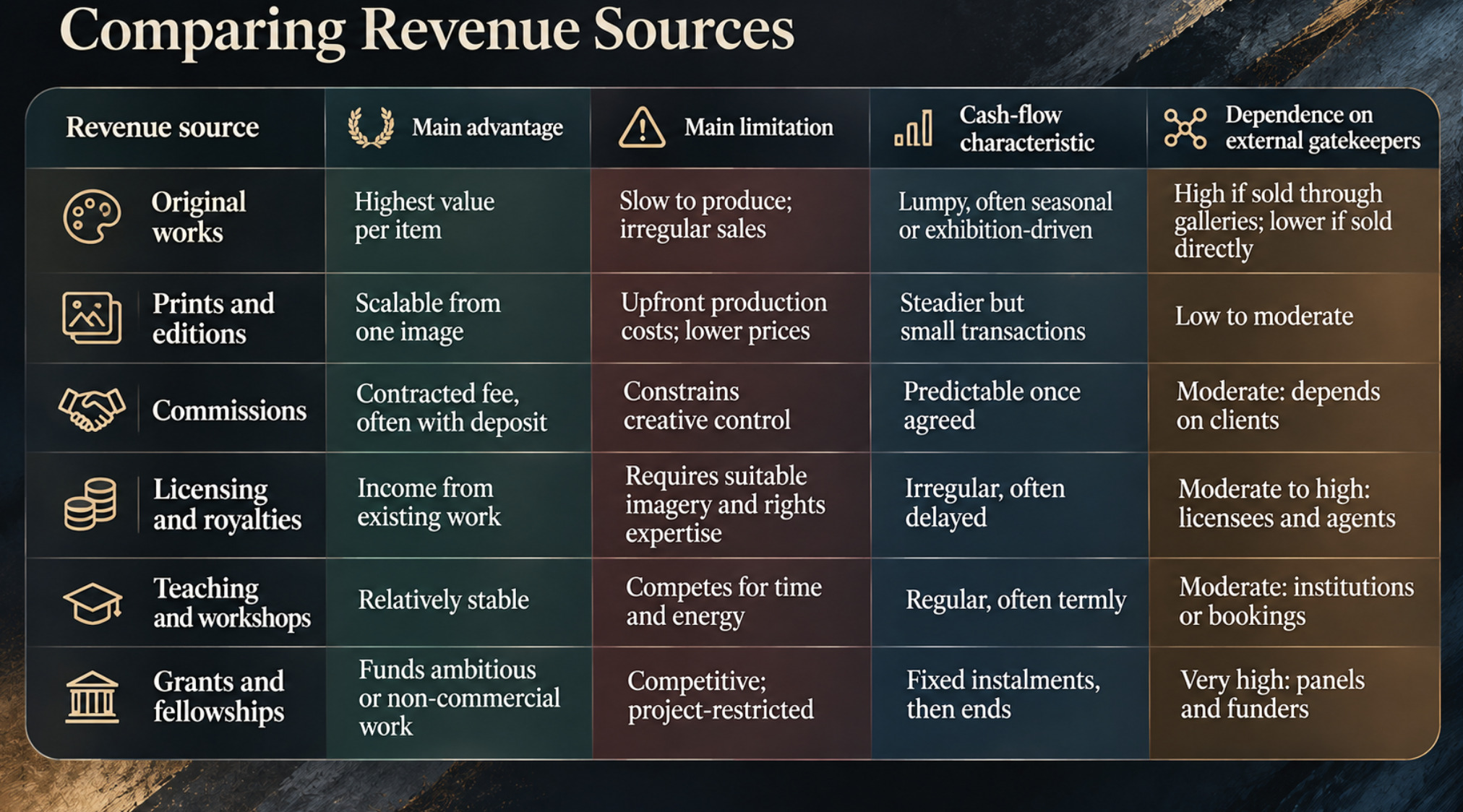
Diversification reduces exposure to any single source, but each additional stream adds contracts, records and decisions. Beyond a point, the administrative workload of managing many small income streams can itself become a cost — measured in the hours no longer available for making work.
The problems individual artists cannot solve alone
Much professional advice to artists concerns individual decisions: price your work properly, build a mailing list, diversify income, negotiate contracts. These matter. But it would be misleading to suggest that careful business practice can overcome the conditions in which artists work. Several are structural.
Unequal access to funding and opportunity. The DACS-commissioned research found substantial earnings gaps by gender, ethnicity and socio-economic background. Artists from less privileged backgrounds are less likely to have family support during unpaid early-career years, savings to absorb an unprofitable exhibition, or the confidence and connections that help in grant applications and gallery relationships.
Geographic concentration. Commercial galleries, major institutions, collectors and much of the press remain concentrated in London, even as public funding has been partly redistributed to other regions. Artists elsewhere face higher travel costs to reach markets, while London-based artists face some of the highest studio and living costs in the country.
Rising costs. Studio rents, materials, energy, shipping and insurance have all risen, while artists' prices and fees have often not kept pace. Affordable studio providers exist, but demand exceeds supply in many areas, and property development frequently displaces artists' workspaces.
Unpaid labour. The expectation that artists will exhibit, speak, contribute or apply without payment remains embedded across parts of the sector. Campaigns by a-n, Artists' Union England and others for fair pay have shifted practice in some institutions, but not across the whole ecosystem.
Market concentration. At the top of the art market, value is highly concentrated among a small number of artists, galleries and auction houses. The visibility of those exceptional successes distorts perceptions of what an artistic career typically yields.
Accessibility. Disabled artists face additional costs and barriers, from inaccessible venues to application processes that assume particular ways of working. Support for access costs exists within some funding programmes, but access barriers remain widespread.
Economic and policy uncertainty. Public arts budgets, local authority funding and education policy all shape the opportunities available to artists, and all have been under pressure in recent years. The temporary closure of Creative Scotland's individual fund in 2024 showed how quickly support can disappear.
Distinguishing individual choices from structural conditions matters, because the alternative is to blame artists for outcomes produced by markets and policy. An artist who prices carefully, works hard and builds strong relationships can still struggle — not because they failed, but because the system offers too few routes to a sustainable living.
What sustainability actually looks like
If sustainability does not mean fame, and does not necessarily mean living entirely from sales, what does it mean? A more useful definition asks whether an artist can continue to make meaningful work over time without unacceptable harm to their finances, health or independence. That depends on several dimensions at once.
Financial viability — total income, from all sources, sufficient to cover living and practice costs, with some margin. Predictable cash flow — enough regular income, or enough reserves, to survive the gaps between irregular payments. Creative autonomy — the ability to decide what work to make, rather than having every choice dictated by what sells or what funders want. Professional relationships — trusted collaborators, institutions, galleries or collectors who sustain a practice over years rather than single transactions. Rights management — understanding and protecting copyright, licensing and resale rights, so that the value of work is not lost. Time for development — protected periods for research, experimentation and reflection, without which practice stagnates. Health and workload — manageable hours, rest and the absence of chronic financial stress. And long-term resilience — savings, pension provision and the capacity to absorb shocks such as illness, a lost gallery or a funding cut.
Sustainability looks different across disciplines and career stages. An emerging artist may reasonably prioritise development and accept a higher share of non-art income; a mid-career artist may seek a better balance between commercial work and independent practice; a socially engaged artist may depend more on institutional and public funding than on sales. Success should not be measured solely by sales or public recognition. A career sustained modestly over decades, producing serious work and contributing to communities, may represent a more meaningful achievement than a brief period of market attention.
Visibility is not the same as independence
Return to the painter with the large following and the empty account. Nothing in her situation suggests a lack of talent or effort. Her audience is real; her work clearly resonates. What she lacks is an economic structure that converts recognition into a livelihood: relationships that lead to sales and commissions, income streams that arrive regularly enough to pay the rent, rights that keep earning after the first transaction, and support that allows ambitious work to be made without personal debt.
Some of those structures she can build herself — a mailing list, a clearer pricing strategy, a deliberate mix of teaching and studio time, a written agreement with any future gallery. Others depend on institutions, funders, markets and policy: on whether exhibitions pay fees, whether funding for individuals survives the next budget, whether studios remain affordable, and whether opportunity is distributed beyond those with existing advantages.
A sustainable artistic career, then, is neither a reward for virtue nor a product of visibility. It is the result of an interplay between individual decisions and collective conditions. Artists can improve their odds through careful professional practice. But independence — the capacity to keep making meaningful work over a lifetime — also depends on a cultural economy that values that work enough to pay for it.

Written by Martha Ellison